
Arduino Boards
Filter products

Uno The UNO is the best board to get started with electronics and coding. If this is your first experience tinkering with the platform, the UNO is the most robust board you can start playing with. The UNO is the most used and documented board of the whole Arduino family. Produktübersicht Arduino Uno is a microcontroller board based on the ATmega328P (datasheet). It has 14 digital input/output pins (of which 6 can be used as PWM outputs), 6 analog inputs, a 16 MHz quartz crystal, a USB connection, a power jack, an ICSP header and a reset button. It contains everything needed to support the microcontroller; simply connect it to a computer with a USB cable or power it with a AC-to-DC adapter or battery to get started.. You can tinker with your UNO without worring too much about doing something wrong, worst case scenario you can replace the chip for a few dollars and start over again. "Uno" means one in Italian and was chosen to mark the release of Arduino Software (IDE) 1.0. The Uno board and version 1.0 of Arduino Software (IDE) were the reference versions of Arduino, now evolved to newer releases. The Uno board is the first in a series of USB Arduino boards, and the reference model for the Arduino platform; for an extensive list of current, past or outdated boards see the Arduino index of boards. Technische Spezifikationen Microcontroller ATmega328P Operating Voltage 5V Input Voltage (recommended) 7-12V Input Voltage (limit) 6-20V Digital I/O Pins 14 (of which 6 provide PWM output) PWM Digital I/O Pins 6 Analog Input Pins 6 DC Current per I/O Pin 20 mA DC Current for 3.3V Pin 50 mA Flash Memory 32 KB (ATmega328P) of which 0.5 KB used by bootloader SRAM 2 KB (ATmega328P) EEPROM 1 KB (ATmega328P) Clock Speed 16 MHz LED_BUILTIN 13 Length 68.6 mm Width 53.4 mm Weight 25 g
Available, delivery time: 1-2 Tage

Der Arduino GIGA R1 WiFi wurde für ambitionierte Maker entwickelt. Es bietet die Möglichkei für Gamer, Künstler, Sounddesigner und jeden, der mit großen Ideen und kleinem Budget in die Tech-Welt einzusteigen - weil es fortschrittliche Funktionen in ein handliches Board packt, mit dem gleichen Formfaktor wie die beliebten Mega und Due. Funktionalität des Boards: Mikrocontroller (STM32H747XI): Dieser Dual-Core-Mikrocontroller mit 32 Bits ermöglicht es Ihnen, zwei Prozessoren miteinander kommunizieren zu lassen (einen Cortex®-M7 mit 480 MHz und einen Cortex®-M4 mit 240 MHz). Sie können sogar Micropython auf dem einen und Arduino auf dem anderen ausführen. Drahtlose Kommunikation (Murata 1DX): Egal, ob Sie Wi-Fi® oder Bluetooth® bevorzugen, der GIGA R1 WiFi bietet Ihnen alles. Sie können sich sogar schnell mit der Arduino IoT Cloud verbinden und Ihr Projekt aus der Ferne verfolgen. Und wenn Sie sich Sorgen um die Sicherheit der Kommunikation machen, hat der ATECC608A alles unter Kontrolle. Hardware-Anschlüsse und Kommunikation: In Anlehnung an den Arduino Mega und den Arduino Due verfügt der GIGA R1 WiFi über 4 UARTs (serielle Hardware-Ports), 3 I2C-Ports (1 mehr als bei den Vorgängern), 2 SPI-Ports (1 mehr als bei den Vorgängern), 1 FDCAN. GPIOs und zusätzliche Pins: Es sollte der gleiche Formfaktor des Mega und des Due beibehalten werden, so dass Sie Ihre kundenspezifischen Shields leicht an das GIGA R1 WiFi anpassen können (denken Sie aber daran, dass dieses Board mit 3,3V arbeitet!), und wir haben zusätzliche Header hinzugefügt, um auf zusätzliche Pins zuzugreifen, so dass die Gesamtzahl der GPIO-Pins 76 beträgt, und das Beste daran ist, dass Sie von unten darauf zugreifen können, so dass Sie Ihr Projekt so belassen können, wie es ist, und einfach darüber nachdenken, wie Sie es erweitern können. Außerdem haben wir zwei neue Pins hinzugefügt: einen VRTC, an den man eine Batterie anschließen kann, um die RTC weiterlaufen zu lassen, während das Board ausgeschaltet ist, und einen OFF-Pin, mit dem man das Board abschalten kann. Steckverbinder: Das GIGA R1 WiFi hat zusätzliche Anschlüsse auf dem Board, die die Erstellung Ihres Projekts ohne zusätzliche Hardware erleichtern. Dieses Board hat: • USB-A-Anschluss für den Anschluss von USB-Sticks, anderen Massenspeichern und HID-Geräten wie Tastatur oder Maus. • 3,5-mm-Eingangs-/Ausgangsbuchse für den Anschluss an DAC0, DAC1 und A7. • USB-C® zur Stromversorgung und Programmierung des Boards sowie zur Simulation eines HID-Geräts wie Maus oder Tastatur. • Jtag-Anschluss, 2x5 1,27mm. • 20-poliger Arducam-Kamerastecker. Unterstützung höherer Spannungen: Im Vergleich zu seinen Vorgängern, die bis zu 12 Volt unterstützen, kann das GIGA R1 WiFi einen Bereich von 6 bis 24 Volt verarbeiten.
Available, delivery time: 1-2 Tage

The ease of use of a Nano board with the addition of secure IoT and BT connectivity. This small, robust and powerful board has WiFi and Bluetooth connectivity that combined with its low power architecture makes it a practical and cost effective solution for your connected projects. Arduino Nano 33 IoT is fully compatible with the Arduino IoT Cloud and supports full TLS secure transport: the ATECC608A cryptochip stores the cryptographic keys in hardware, offering a very high level of security for this class of products. The integration with the Arduino IoT Cloud offers also a very efficient way of setting up online dashboards with little coding and minimal effort. In the same iconic size of the Arduino Nano, the Arduino Nano 33 IoT hosts an Arm Cortex-M0+ SAMD21 processor, a WiFi and Bluetooth module based on ESP32, a 6 axis Inertial Measurement Unit (IMU) and a crypto chip which can securely store certificates and pre shared keys. The board can either be used in a breadboard (when mounting pin headers), or as a SMT module, directly soldering it via the castellated pads.
Available, delivery time: 1-2 Tage

Why should you buy this product? – It’s the only RP2040 board with connectivity. – It’s the only RP2040 board in the well-known and very popular Nano form factor with castellated pads. – It’s the most versatile RP2040 board because of the additional features - 6-axis IMU, microphone, RGB LED etc – It’s a powerful Arduino board for makers - more RAM and dual-core, allowing new projects – Its IMU has machine learning capabilities, thus additional detection algorithms – Microphone to make voice-enabled projects – The ESP32 core on-board can be used as co-processor
Available, delivery time: 1-2 Tage
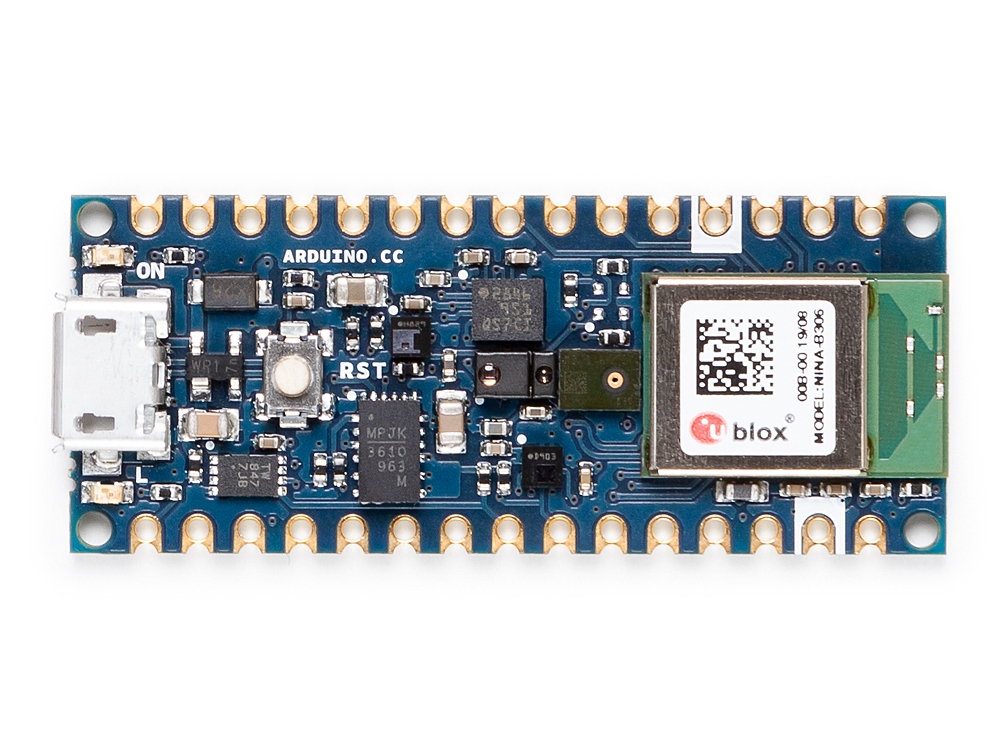
Designed for short range BT interactions and power savvy projects. This compact and reliable Nano board is built around the NINA B306 module, based on Nordic nRF 52840 and containing a powerful Cortex M4F. Its architecture, fully compatible with Arduino IDE Online and Offline, has a 9 axis Inertial Measurement Unit (IMU) and a reduced power consumption compared to other same size boards. This allows the design of wearable devices and movement sensing projects that need to communicate to other devices at a close range. Arduino Nano 33 BLE is also ideal for automation projects thanks to the multiprotocol BT 5.0 radio. With headers mounted.
Not in stock

Mega 2560 The MEGA 2560 is designed for more complex projects. With 54 digital I/O pins, 16 analog inputs and a larger space for your sketch it is the recommended board for 3D printers and robotics projects. This gives your projects plenty of room and opportunities. Produktübersicht The Arduino Mega 2560 is a microcontroller board based on the ATmega2560. It has 54 digital input/output pins (of which 15 can be used as PWM outputs), 16 analog inputs, 4 UARTs (hardware serial ports), a 16 MHz crystal oscillator, a USB connection, a power jack, an ICSP header, and a reset button. It contains everything needed to support the microcontroller; simply connect it to a computer with a USB cable or power it with a AC-to-DC adapter or battery to get started. The Mega 2560 board is compatible with most shields designed for the Uno and the former boards Duemilanove or Diecimila. The Mega 2560 is an update to the Arduino Mega, which it replaces. Technische Spezifikationen Microcontroller ATmega2560 Operating Voltage 5V Input Voltage (recommended) 7-12V Input Voltage (limit) 6-20V Digital I/O Pins 54 (of which 15 provide PWM output) Analog Input Pins 16 DC Current per I/O Pin 20 mA DC Current for 3.3V Pin 50 mA Flash Memory 256 KB of which 8 KB used by bootloader SRAM 8 KB EEPROM 4 KB Clock Speed 16 MHz LED_BUILTIN 13 Length 101.52 mm Width 53.3 mm Weight 37 g
Available, delivery time: 1-2 Tage

Micro Arduino Micro is the smallest board of the family, easy to integrate it in everyday objects to make them interactive. The Micro is based on the ATmega32U4 microcontroller featuring a built-in USB which makes the Micro recognisable as a mouse or keyboard. Produktübersicht The Micro is a microcontroller board based on the ATmega32U4 (datasheet), developed in conjunction with Adafruit. It has 20 digital input/output pins (of which 7 can be used as PWM outputs and 12 as analog inputs), a 16 MHz crystal oscillator, a micro USB connection, an ICSP header, and a reset button. It contains everything needed to support the microcontroller; simply connect it to a computer with a micro USB cable to get started. It has a form factor that enables it to be easily placed on a breadboard. The Micro board is similar to the Arduino Leonardo in that the ATmega32U4 has built-in USB communication, eliminating the need for a secondary processor. This allows the Micro to appear to a connected computer as a mouse and keyboard, in addition to a virtual (CDC) serial / COM port. It also has other implications for the behavior of the board; these are detailed on the getting started page. Technische Spezifikationen Microcontroller ATmega32U4 Operating Voltage 5V Input Voltage (recommended) 7-12V Input Voltage (limit) 6-20V Digital I/O Pins 20 PWM Channels 7 Analog Input Channels 12 DC Current per I/O Pin 20 mA DC Current for 3.3V Pin 50 mA Flash Memory 32 KB (ATmega32U4) of which 4 KB used by bootloader SRAM 2.5 KB (ATmega32U4) EEPROM 1 KB (ATmega32U4) Clock Speed 16 MHz LED_BUILTIN 13 Length 48 mm Width 18 mm Weight 13 g
Available, delivery time: 1-2 Tage
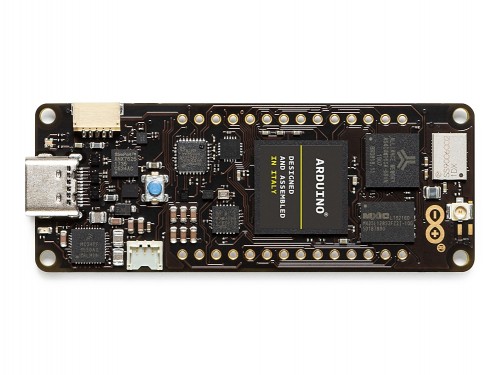
Portenta H7 führt gleichzeitig High-Level-Code zusammen mit Echtzeitaufgaben aus. Das Design umfasst zwei Prozessoren, die Aufgaben parallel ausführen können. Zum Beispiel ist es möglich, Arduino kompilierten Code zusammen mit MicroPython auszuführen und beide Prozessoren miteinander kommunizieren zu lassen. Die Portenta-Funktionalität ist zweigeteilt, sie kann entweder wie jedes andere Embedded-Mikrocontroller-Board oder als Hauptprozessor eines Embedded-Computers betrieben werden. Verwenden Sie zum Beispiel das Portenta Vision Shield, um Ihren H7 in eine Industriekamera zu verwandeln, die in der Lage ist, maschinelle Lernalgorithmen in Echtzeit auf Live-Videobildern auszuführenPortenta kann problemlos Prozesse ausführen, die mit TensorFlow™ Lite erstellt wurden. Sie könnten einen der Rechenkerne einen Computer-Vision-Algorithmus im laufenden Betrieb berechnen lassen, während der andere Low-Level-Operationen wie die Steuerung eines Motors durchführt oder als Benutzeroberfläche fungiert.
Not in stock
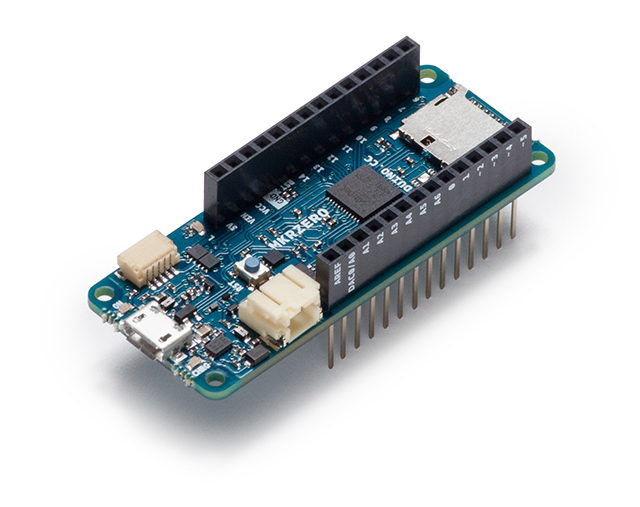
MKR Zero MKR ZERO has an on-board SD connector with dedicated SPI interfaces (SPI1) that allows you to play with MUSIC files with no extra hardware! Watch out music makers, we’ve got some news for you! We have released two libraries for your enjoyment: Arduino Sound library – a simple way to play and analyze audio data using Arduino on SAM D21-based boards. I2S library – to use the I2S protocol on SAMD21-based boards. For those who don’t know, I2S (Inter-IC Sound) is an electrical serial bus interface standard for connecting digital audio devices Produktübersicht The MKR ZERO brings you the power of a Zero in the smaller format established by the MKR form factor. The MKR ZERO board acts as a great educational tool for learning about 32-bit application development. It has an on-board SD connector with dedicated SPI interfaces (SPI1) that allows you to play with MUSIC files with no extra hardware! The board is powered by Atmel’s SAMD21 MCU, which features a 32-bit ARM Cortex® M0+ core. Warning: Unlike most Arduino & Genuino boards, the MKRZero runs at 3.3V. The maximum voltage that the I/O pins can tolerate is 3.3V. Applying voltages higher than 3.3V to any I/O pin could damage the board. The board contains everything needed to support the microcontroller; simply connect it to a computer with a micro-USB cable or power it by a LiPo battery. The battery voltage can also be monitored since a connection between the battery and the analog converter of the board exists. Technische Spezifikationen Microcontroller SAMD21 Cortex-M0+ 32bit low power ARM MCU Board Power Supply (USB/VIN) 5V Supported Battery(*) Li-Po single cell, 3.7V, 700mAh minimum DC Current for 3.3V Pin 600mA DC Current for 5V Pin 600mA Circuit Operating Voltage 3.3V Digital I/O Pins 22 PWM Pins 12 (0, 1, 2, 3, 4, 5, 6, 7, 8, 10, A3 - or 18 -, A4 -or 19) UART 1 SPI 1 I2C 1 Analog Input Pins 7 (ADC 8/10/12 bit) Analog Output Pins 1 (DAC 10 bit) External Interrupts 8 (0, 1, 4, 5, 6, 7, 8, A1 -or 16-, A2 - or 17) DC Current per I/O Pin 7 mA Flash Memory 256 KB Flash Memory for Bootloader 8 KB SRAM 32 KB EEPROM no Clock Speed 32.768 kHz (RTC), 48 MHz LED_BUILTIN 32 Full-Speed USB Device and embedded Host
Available, delivery time: 1-2 Tage
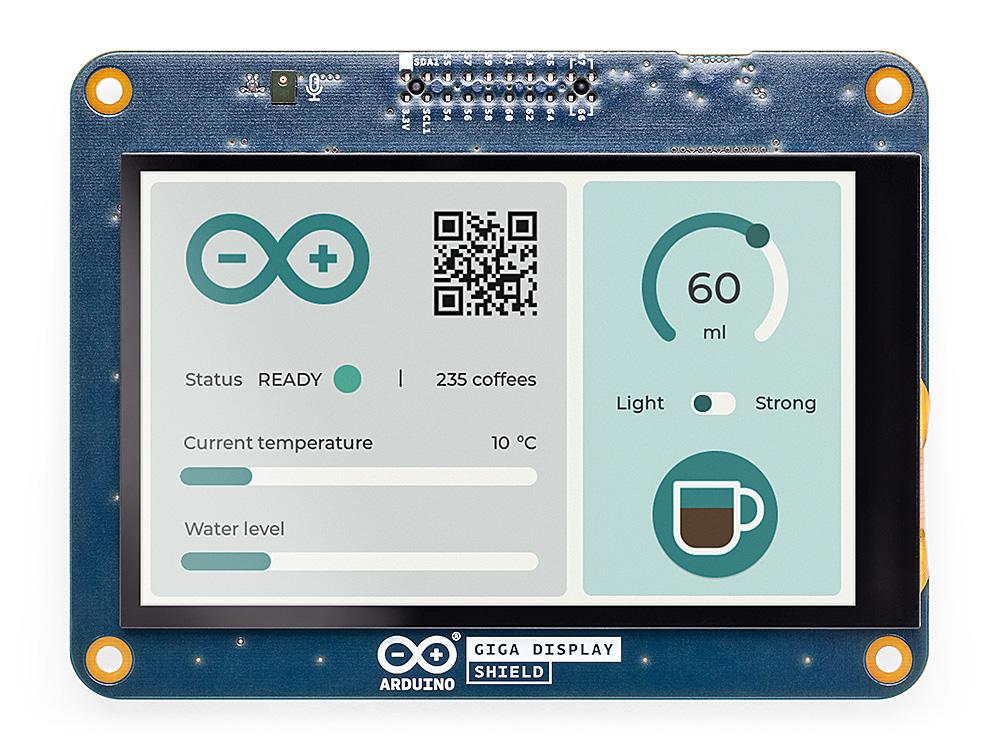
Das GIGA Display Shield ist eine Touchscreen-Lösung, mit der Sie mühelos grafische Schnittstellen in Ihren Projekten insbesondere mit dem GIGA R! WIFI Board einsetzen können. Durch die Nutzung des neuen Stiftleistenanschlusses in der Mitte des GIGA R1 WiFi bietet dieses Shield eine nahtlose Integration und erweiterte Funktionalitäten. Mit dem GIGA Display Shield erhalten Sie Zugang zu einer Reihe von Funktionen, darunter ein digitales Mikrofon, eine 6-Achsen-IMU und ein Arducam-Anschluss. Mit diesen zusätzlichen Funktionen können Sie die anderen 54 verfügbaren Pins voll ausnutzen, was die Erstellung von Handheld-Geräten oder Dashboards zur Steuerung Ihres Projekts unglaublich bequem macht. Dank des benutzerfreundlichen Designs und der umfassenden Funktionen des GIGA Display Shields können Sie mit Leichtigkeit intuitive Schnittstellen erstellen. Verbessern Sie die Funktionalität und Benutzerfreundlichkeit Ihres Projekts mit dieser innovativen Lösung.
Available, delivery time: 1-2 Tage
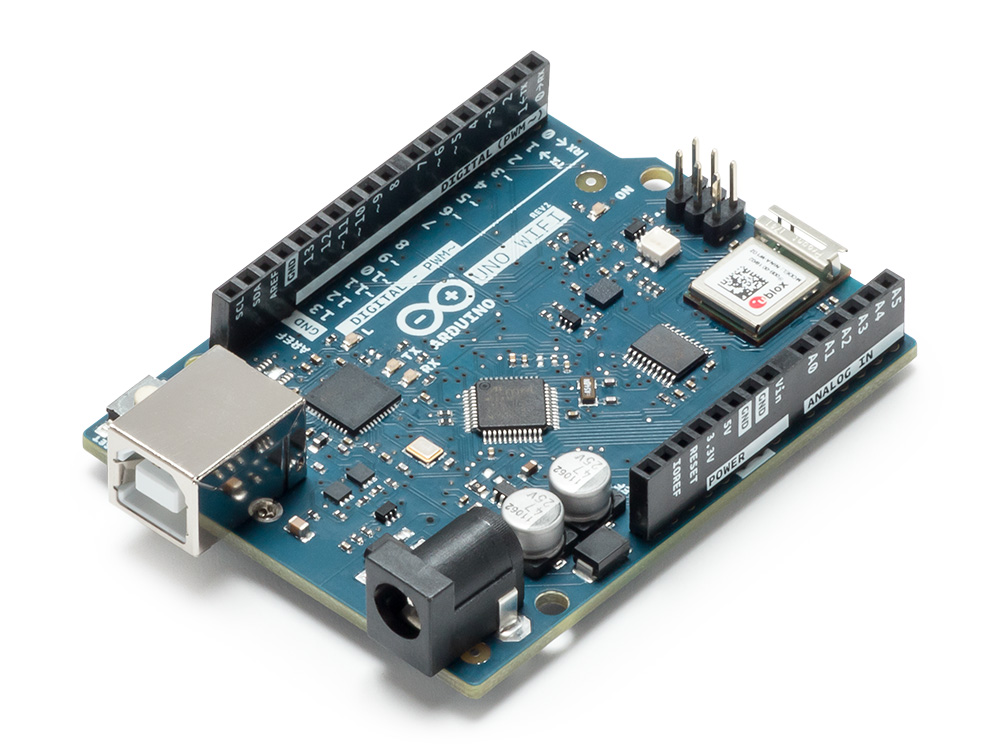
Uno WiFi Add WiFI to your devices with the Arduino Uno WiFi. It's basically an Arduino Uno Rev3 with more kick: It comes with a brand new 8-bit microprocessor from Microchip, and an onboard IMU (Inertial Measurement Unit). As for the WiFi connection, that's made secure with the new ECC608 crypto chip accelerator. Produktübersicht Add this board to a device and you'll be able to connect it to a WiFi network, using its secure ECC608 crypto chip accelerator. The Arduino Uno WiFi is functionally the same as the Arduino Uno Rev3, but with the addition of WiFi and some other enhancements. It incorporates a brand new 8-bit microprocessor from Microchip and has an onboard IMU (Inertial Measurement Unit). The Wi-Fi Module is a self-contained SoC with integrated TCP/IP protocol stack that can provide access to a Wi-Fi network, or act as an access point. It supports OTA (over-the-air) programming, either for transfer of Arduino sketches or Wi-Fi firmware. The Arduino Uno WiFi has 14 digital input/output pins—6 can be used as PWM outputs—6 analog inputs, a 16 MHz ceramic resonator, a USB connection, a power jack, an ICSP header, and a reset button. It contains everything needed to support the microcontroller. Simply connect it to a computer with a USB cable or power it with an AC adapter or battery to get started. Technische Spezifikationen Microcontroller ATMEGA4809 Operating Voltage 5V Input Voltage (recommended) 7 - 12V Input Voltage (limit) 6 - 20V Digital I/O Pins 14 — 6 Provide PWM Output PWM Digital I/O Pins 6 Analog Input Pins 6 DC Current per I/O Pin 20 mA DC Current for 3.3V Pin 50 mA Flash Memory 48 KB (ATMEGA4809) SRAM 6,144 KB (ATMEGA4809) EEPROM 256 Bytes (ATMEGA4809) Clock Speed 16 MHz LED_BUILTIN 13 Length 68.6 mm Width 53.4 mm Weight 25 g
Not in stock

Das Arduino MKR WAN 1310 Board bietet eine praktische und kostengünstige Lösung, um LoRa® Konnektivität zu Projekten hinzuzufügen, die einen geringen Stromverbrauch benötigen. Dieses Open-Source-Board kann verbunden werden mit der Arduino IoT-Cloud, Ihrem eigenen LoRa®-Netzwerk mittels des Arduino LoRa® PRO-Gateways, einer bestehenden LoRaWAN™-Infrastruktur wie The Things Network oder sogar mit anderen Boards, die den Direct-Connectivity-Modus nutzen. Das MKR WAN 1310 bringt im Vergleich zu seinem Vorgänger, dem MKR WAN 1300, eine Reihe von Verbesserungen mit sich. Das MKR WAN 1310 basiert zwar immer noch auf dem Microchip® SAMD21 Low-Power-Prozessor, dem Murata CMWX1ZZABZ LoRa®-Modul und dem charakteristischen Krypto-Chip der MKR-Familie (dem ECC508), verfügt aber über ein neues Batterielader, einen 2 MByte großen SPI-Flash und eine verbesserte Regelung des Stromverbrauchs des Boards. Die letzten Modifikationen haben die Batterielebensdauer des MKR WAN 1310 erheblich verbessert. Bei richtiger Konfiguration liegt der Stromverbrauch jetzt bei nur 104uA! Es ist außerdem möglich, das Board über den USB-Port mit Strom (5V) zu versorgen.Datenlogging und andere OTA-Funktionen (Over The Air) sind jetzt möglich, da das Board über einen 2 MByte großen Flash-Speicher verfügt. Mit dieser neuen Funktion können Sie Konfigurationsdateien von der Infrastruktur auf das Board übertragen (2 MByte Flash), eigene Skriptbefehle erstellen oder einfach Daten lokal speichern, um die Daten zu senden, wenn die Verbindung am besten ist. Der Krypto-Chip des MKR WAN 1310 sorgt für zusätzliche Sicherheit, indem er Anmeldedaten und Zertifikate im eingebetteten Secure Element speichert. Specs: Microcontroller SAMD21 Cortex®-M0+ 32bit low power ARM MCU Radio module CMWX1ZZABZ Board Power Supply (USB/VIN) 5V Secure Element ATECC508 Supported Batteries rechargeable Li-Ion, or Li-Po, 1024 mAh minimum capacity Circuit Operating Voltage 3.3V Digital I/O Pins 8 PWM Pins 13 (0 .. 8, 10, 12, 18 / A3, 19 / A4) UART 1 SPI 1 I2C 1 Analog Input Pins 7 (ADC 8/10/12 bit) Analog Output Pins 1 (DAC 10 bit) External Interrupts 10 (0, 1, 4, 5, 6, 7, 8, 9, 16 / A1, 17 / A2) DC Current per I/O Pin 7 mA CPU Flash Memory 256 KB (internal) QSPI Flash Memory 2MByte (external) SRAM 32 KB EEPROM no Clock Speed 32.768 kHz (RTC), 48 MHz LED_BUILTIN 6 USB Full-Speed USB Device and embedded Host Antenna gain 2dB (bundled pentaband antenna) Carrier frequency 433/868/915 MHz Working region EU/US (confirmed) other countries check your region's spectrum availability Length 67.64 mm Width 25 mm Weight 32 gr.
Available, delivery time: 1-2 Tage

Nano The Arduino Nano is a compact board similar to the UNO. Produktübersicht The Arduino Nano is a small, complete, and breadboard-friendly board based on the ATmega328 (Arduino Nano 3.x). It has more or less the same functionality of the Arduino Duemilanove, but in a different package. It lacks only a DC power jack, and works with a Mini-B USB cable instead of a standard one. Technische Spezifikationen Microcontroller ATmega328 Architecture AVR Operating Voltage 5 V Flash Memory 32 KB of which 2 KB used by bootloader SRAM 2 KB Clock Speed 16 MHz Analog IN Pins 8 EEPROM 1 KB DC Current per I/O Pins 40 mA (I/O Pins) Input Voltage 7-12 V Digital I/O Pins 22 (6 of which are PWM) PWM Output 6 Power Consumption 19 mA PCB Size 18 x 45 mm Weight 7 g Product Code A000005
Available, delivery time: 1-2 Tage

Small, powerful, BT connected and with all the sensors you may need to design innovative applications. This compact and reliable Nano board is built around the NINA B306 module for BLE and Bluetooth 5 communication; the module is based on Nordic nRF 52840 processor that contains a powerful Cortex M4F and the board has a rich set of sensors that allow the creation of innovative and highly interactive designs. Its architecture, fully compatible with Arduino IDE Online and Offline, has a 9 axis Inertial Measurement Unit (IMU), temperature, pressure, humidity, light, color and even gestures sensors and a microphone that are managed through our specialised libraries. Its reduced power consumption, compared to other same size boards, together with the Nano form factor opens up a wide range of applications. This allows the design of wearable devices and gesture based projects that need to communicate to other devices at a close range. Arduino Nano 33 BLE Sense is ideal for interactive automation projects thanks to the multiprotocol BT 5.0 radio. With headers mounted.
Available, delivery time: 1-2 Tage

MKR ZERO has an on-board SD connector with dedicated SPI interfaces (SPI1) that allows you to play with MUSIC files with no extra hardware! Watch out music makers, we’ve got some news for you! We have released two libraries for your enjoyment: Arduino Sound library – a simple way to play and analyze audio data using Arduino on SAM D21-based boards. I2S library – to use the I2S protocol on SAMD21-based boards. For those who don’t know, I2S (Inter-IC Sound) is an electrical serial bus interface standard for connecting digital audio devices. Microcontroller SAMD21 Cortex-M0+ 32bit low power ARM MCU Board Power Supply (USB/VIN) 5V Supported Battery(*) Li-Po single cell, 3.7V, 700mAh minimum Circuit Operating Voltage 3.3V Digital I/O Pins 8 PWM Pins 12 (0, 1, 2, 3, 4, 5, 6, 7, 8, 10, A3 - or 18 -, A4 -or 19) UART 1 SPI 1 I2C 1 Analog Input Pins 7 (ADC 8/10/12 bit) Analog Output Pins 1 (DAC 10 bit) External Interrupts 8 (0, 1, 4, 5, 6, 7, 8, A1 -or 16-, A2 - or 17) DC Current per I/O Pin 7 mA Flash Memory 256 KB SRAM 32 KB EEPROM no Clock Speed 32.768 kHz (RTC), 48 MHz LED_BUILTIN 6 Full-Speed USB Device and embedded Host LED_BUILTIN 6 Lenght 61.5 mm Width 25 mm Weight 32 gr.
Not in stock

Classification Device CoreARM Cortex M3 Name Arduino Due Processor Family NameSAM3XE Processor Part NumberAtmel SAM3X8E Processor TypeCPU Arduino Due Development Boards The Arduino Due board features a 32-bit SAM3X8E ARM Cortex-M3 microcontroller and comes in two versions: 7697412 with headers and 8474888 without headers. To power up your Due board and get started, you can either connect it to a computer using a micro USB cable or use an AC-DC adaptor/battery. Unlike other Arduino boards, the Due can only be powered at 3.3 V. Features & Benefits of the Arduino Due •54 digital I/O pins (12 of which can be used as PWM outputs) •12 analog inputs •4 UARTs •84 MHz clock •96 kBytes of SRAM •512 kBytes of flash memory •DMA controller that supports the CPU with high memory tasks •USB On-The-Go (OTG) connectivity •2 DAC •2 TWI •Power jack •SPI header •JTAG header •Reset & erase button •Dimensions:101.52 mm x 53.3 mm •Compatible with Arduino Shields that use 3.3 V power supply and are compliant with the 1.0 Arduino pinout
Available, delivery time: 1-2 Tage

Leonardo Similar to an Arduino UNO, can be recognized by computer as a mouse or keyboard. Produktübersicht The Arduino Leonardo is a microcontroller board based on the ATmega32u4 (datasheet). It has 20 digital input/output pins (of which 7 can be used as PWM outputs and 12 as analog inputs), a 16 MHz crystal oscillator, a micro USB connection, a power jack, an ICSP header, and a reset button. It contains everything needed to support the microcontroller; simply connect it to a computer with a USB cable or power it with a AC-to-DC adapter or battery to get started. The Leonardo differs from all preceding boards in that the ATmega32u4 has built-in USB communication, eliminating the need for a secondary processor. This allows the Leonardo to appear to a connected computer as a mouse and keyboard, in addition to a virtual (CDC) serial / COM port. It also has other implications for the behavior of the board; these are detailed on the getting started page. Technische Spezifikationen Microcontroller ATmega32u4 Operating Voltage 5V Input Voltage (Recommended) 7-12V Input Voltage (limits) 6-20V Digital I/O Pins 20 PWM Channels 7 Analog Input Channels 12 DC Current per I/O Pin 40 mA DC Current for 3.3V Pin 50 mA Flash Memory 32 KB (ATmega32u4) of which 4 KB used by bootloader SRAM 2.5 KB (ATmega32u4) EEPROM 1 KB (ATmega32u4) Clock Speed 16 MHz Lenght 68.6 mm Width 53.3 mm Weight 20 g
Available, delivery time: 1-2 Tage

WLAN! Möchten Sie Ihren Geräten eine WiFi-Schnittstelle hinzufügen? Holen Sie sich das MKR WIFI 1010! Es lässt sich problemlos mit anderen Arduino-Produkten verbinden und ist mit der Arduino-Software konfigurierbar - und Sie müssen kein Netzwerkexperte sein. Dies ist die neueste Version des MKR 1000 WIFI, jedoch mit einem ESP32-Modul von U-BLOX an Bord. Arduino® MKR WiFi 1010 Der MKR WIFI 1010 ist eine deutliche Verbesserung gegenüber dem MKR 1000 WIFI. Er ist mit einem ESP32-Modul von U-BLOX ausgestattet. Dieses Board zielt darauf ab, das Prototyping von WiFi-basierten IoT-Anwendungen dank der Flexibilität des ESP32-Moduls und seines geringen Stromverbrauchs zu beschleunigen und zu vereinfachen. Technische Spezifikationen Microcontroller SAMD21 Cortex-M0+ 32bit Low Power ARM MCU Board Power Supply (USB/VIN) 5V Supported Battery(*) Li-Po Single Cell, 3.7V, 700mAh Minimum Circuit Operating Voltage 3.3V Digital I/O Pins 8 PWM Pins 12 (0, 1, 2, 3, 4, 5, 6, 7, 8, 10, A3 - or 18 -, A4 -or 19) UART 1 SPI 1 I2C 1 I2S 1 Connectivity WiFi Analog Input Pins 7 (ADC 8/10/12 bit) Analog Output Pins 1 (DAC 10 bit) External Interrupts 8 (0, 1, 4, 5, 6, 7, 8, A1 -or 16-, A2 - or 17) DC Current per I/O Pin 7 mA Flash Memory 256 KB SRAM 32 KB EEPROM No Clock Speed 32.768 kHz (RTC), 48 MHz LED_BUILTIN 6 Full-Speed USB Device and Embedded Host Included LED_BUILTIN 6 Length 61.5 mm Width 25 mm Weight 32 gr.
Available, delivery time: 1-2 Tage

Turn your ideas into a reality quickly with the new Arduino Nano Every. This small, robust and powerful board has the same classic Nano footprint loved worldwide. It can be programmed with the easy to use Arduino IDE available offline and online. Get started in minutes with thousands of sketches available in open-source or write your own: it is the perfect choice for your everyday projects. Based on the ATMega4809 AVR processor, the Arduino Nano Every is flexible to the requirements of your design. It can be used in a breadboard when mounting pin headers, or as a SMT directly soldered on a PCB thanks to its castellated pads. An SAMD11 ARM Cortex M0+ processor acts as a high performance USB to serial converter that can be re-programmed by skilled users to expand further the applications of this board.
Available, delivery time: 1-2 Tage

Nano The Arduino Nano is a compact board similar to the UNO. Produktübersicht The Arduino Nano is a small, complete, and breadboard-friendly board based on the ATmega328 (Arduino Nano 3.x). It has more or less the same functionality of the Arduino Duemilanove, but in a different package. It lacks only a DC power jack, and works with a Mini-B USB cable instead of a standard one. Technische Spezifikationen Microcontroller ATmega328 Architecture AVR Operating Voltage 5 V Flash Memory 32 KB of which 2 KB used by bootloader SRAM 2 KB Clock Speed 16 MHz Analog IN Pins 8 EEPROM 1 KB DC Current per I/O Pins 40 mA (I/O Pins) Input Voltage 7-12 V Digital I/O Pins 22 (6 of which are PWM) PWM Output 6 Power Consumption 19 mA PCB Size 18 x 45 mm Weight 7 g Product Code A000005
Approximately deliverable on: delivery date unknown
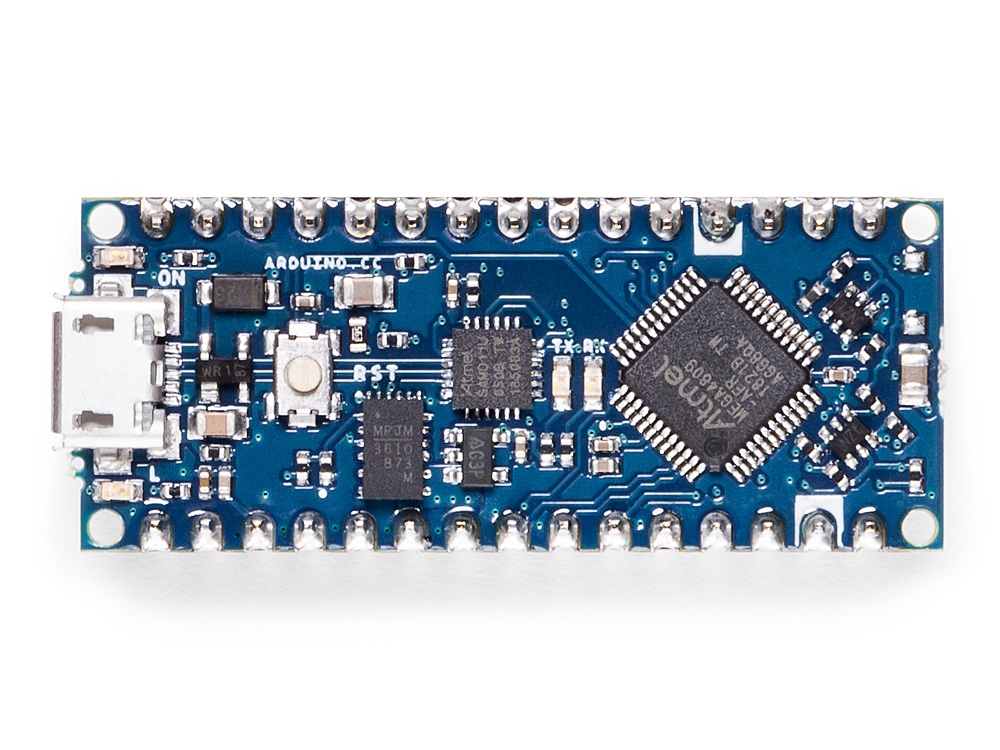
Turn your ideas into a reality quickly with the new Arduino Nano Every. This small, robust and powerful board has the same classic Nano footprint loved worldwide. It can be programmed with the easy to use Arduino IDE available offline and online. Get started in minutes with thousands of sketches available in open-source or write your own: it is the perfect choice for your everyday projects. Based on the ATMega4809 AVR processor, the Arduino Nano Every is flexible to the requirements of your design. It can be used in a breadboard when mounting pin headers, or as a SMT directly soldered on a PCB thanks to its castellated pads. An SAMD11 ARM Cortex M0+ processor acts as a high performance USB to serial converter that can be re-programmed by skilled users to expand further the applications of this board. With headers mounted.
Available, delivery time: 1-2 Tage

Das Portenta Vision Shield LoRa erweitert Ihr Arduino Portenta H7 um industrietaugliche Funktionen. Mit dieser Hardware-Erweiterung können Sie Embedded-Computer-Vision-Anwendungen ausführen, sich drahtlos über LoRa mit der Arduino Cloud oder Ihrer eigenen Infrastruktur verbinden und Ihr System bei der Erkennung von Geräuschereignissen aktivieren. Das Shield verfügt über: - einem 320x320 Pixel Kamerasensor - eine 868/915Mhz LoRa Konnektivität - zwei On-Board-Mikrofone zur Richtungserkennung - JTAG-Anschluss - SD-Card-Anschluss Das Vision Shield Ethernet wurde für die Zusammenarbeit mit dem Arduino Portenta H7 entwickelt. Die Portenta-Boards verfügen über Multicore 32-Bit ARM® Cortex™ Prozessoren, die mit Hunderten von Megahertz laufen, mit Megabytes an Programmspeicher und RAM. Die Portenta-Boards sind mit WiFi und Bluetooth ausgestattet.
Available, delivery time: 1-2 Tage
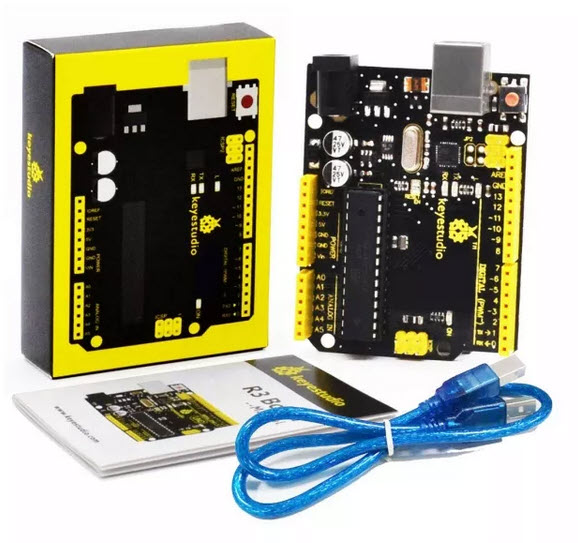
KEYESTUDIO UNO R3 is a microcontroller board based on the ATmega328. It has 14 digital input/output pins (of which 6 can be used as PWM outputs), 6 analo g inputs, a 16 MHz ceramic resonator, a USB connection, a power jack, an ICSP header, and a reset button. It contains everything needed to support the microcontroller; simply connect it to a computer with a USB cable or power it with a AC-to-DC adapter or battery to get started. The Uno R3 differs from all preceding boards in that it does not use the FTDI USB-to-serial driver chip. Instead, it features the Atmega16U2 programmed as a USB-to-serial converter. Package includes: 1 x UNO R3 Development Board 1 x USB Cable
Available, delivery time: 1-2 Tage

Das Portenta Vision Shield erweitert Ihr Arduino Portenta H7 um industrietaugliche Funktionen. Mit dieser Hardware-Erweiterung können Sie Embedded-Computer-Vision-Anwendungen ausführen, sich drahtlos oder über Ethernet mit der Arduino Cloud oder Ihrer eigenen Infrastruktur verbinden und Ihr System bei der Erkennung von Geräuschereignissen aktivieren. Das Shield verfügt über: - einem 320x320 Pixel Kamerasensor - einem 100 Mbps Ethernet-Anschluss - zwei On-Board-Mikrofone zur Richtungserkennung - JTAG-Anschluss - SD-Card-Anschluss Das Vision Shield Ethernet wurde für die Zusammenarbeit mit dem Arduino Portenta H7 entwickelt. Die Portenta-Boards verfügen über Multicore 32-Bit ARM® Cortex™ Prozessoren, die mit Hunderten von Megahertz laufen, mit Megabytes an Programmspeicher und RAM. Die Portenta-Boards sind mit WiFi und Bluetooth ausgestattet.
Available, delivery time: 1-2 Tage